
Minkouma in brief
Project Objective
Today, although the figures do not always receive unanimous agreement, one constant nevertheless emerges among all experts: the electricity supply–demand balance remains fragile, and the deficit could widen significantly by 2028. In practical terms, electricity demand is growing by an average of 150 to 200 MW per year. As a result, the commissioning of new power plants in 2024–2025 will provide the country with only a temporary respite of about two to three years, but no more. The arrival of mining operators, the expansion of the ports of Douala and Kribi, the construction of new cement plants, the expansion of steel mills, and the projected needs of ALUCAM and other industries clearly indicate strong electricity demand from 2028 onward.
In this context, the Minkouma Power Project, which plans to begin commercial operation as early as 2030, aims to contribute to addressing this anticipated electricity deficit. The project therefore pursues two major objectives:
- Support national demand by injecting 70–80% of its production into the national grid through the Ntui substation to meet industrial demand;
- Ensure the electricity supply of the Central Plain of Cameroon. This is a region with vast agro-industrial potential, where many projects have been announced, but which is currently very poorly served by electricity infrastructure;
Finally, due to its strategic location, Minkouma could make a substantial contribution to the electricity interconnection with Chad.
Economic and Financial Model
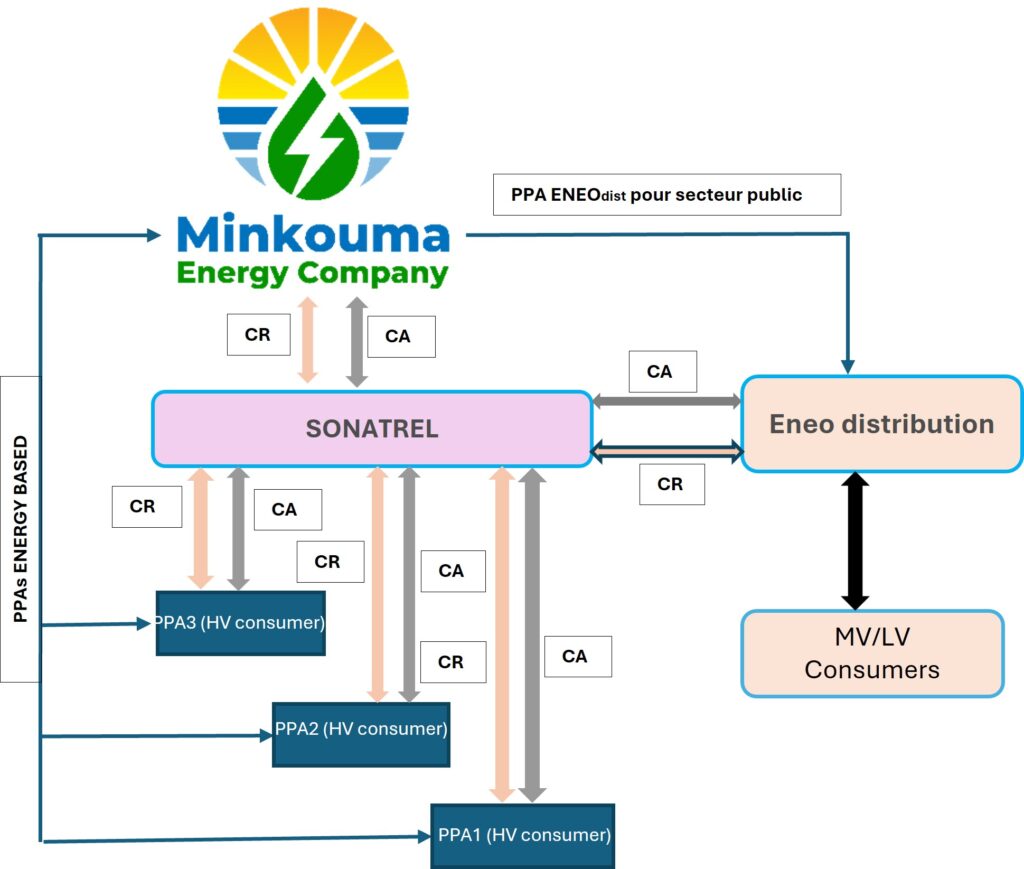
In accordance with the provisions of the 2011 law and its implementing decrees, the economic model of the Minkouma Project is based on placing electricity under multiple power purchase agreements, including 3 to 5 industrial PPAs, with the remaining share supplied to the public sector through the concessionaire of the public electricity service. The sale tariff includes two components, namely:
- a « a variable component » based on the electricity actually consumed, measured symmetrically on both the customer’s side and the producer’s side.
- a « a fixed component » based on the subscribed capacity.
Join our mission
A world of innovations for a fairer, more balanced, and more equitable public-private partnership